Icynene Attic Insulation in Hesperia: A Homeowner’s Guide
Icynene open-cell spray foam can seal an attic cavity in ways no batt or blown-in product can touch, because it expands to roughly 100 times its liquid volume and fills every crack, seam, and odd angle in the framing. But in Hesperia’s high desert climate, that same open-cell structure absorbs moisture vapor, and monsoon humidity can swing 50 points in a single August afternoon. Before you commit to a premium spray foam brand, you need to know exactly when Icynene earns its price tag here, and when it’s the wrong tool for the job. If you’d rather skip the research and get a straight answer for your specific attic, call us at (866) 950-6425 for a free estimate.
At Riverstone Insulation home, we carry Icynene alongside seven other major insulation brands, so we have no incentive to push it where it doesn’t fit. This guide gives you the unfiltered view.
Key Takeaways
- Icynene open-cell foam is an air-sealing product first and an insulator second. It stops airflow far better than batt or blown-in products, but its R-value per inch is modest.
- Open-cell Icynene is vapor-permeable. It lets moisture move through it, which matters a great deal during Hesperia’s July and August humidity swings.
- Icynene makes sense in unvented, conditioned attic assemblies where ductwork runs through the space and air sealing is the actual goal.
- In a vented Hesperia attic, blown-in cellulose from GreenFiber or fiberglass from Owens Corning, Johns Manville, or Knauf typically delivers more R-value per dollar than open-cell spray foam.
- Cost matters. Icynene open-cell runs $1.10 to $1.80 per board foot installed locally, and a typical Hesperia attic of 1,500 to 2,000 square feet can land between $4,200 and $7,600 when applied to the roofline.
What Icynene Actually Is, and the Open-Cell vs. Closed-Cell Distinction That Changes Everything
Icynene is a brand, not a single product. The company makes open-cell spray foam, closed-cell spray foam, and pour-fill foam, and each behaves differently in a Hesperia attic. The most common residential attic application is open-cell Icynene, often sold under product lines like Classic or ProSeal or MD-R-200. Open-cell foam is soft, spongy, and roughly 95% air by volume. It expands aggressively, fills cavities completely, and delivers an R-value of about R-3.6 to R-3.8 per inch.
The structural difference is moisture behavior. Open-cell Icynene is vapor-permeable, meaning water vapor passes through it. Closed-cell spray foam, by contrast, is dense and vapor-resistant or vapor-impermeable depending on thickness. That single difference reshapes the foam decision for every attic in the Victor Valley. Hesperia sits at roughly 3,200 feet of elevation, and while we think of it as dry, monsoon moisture from the Gulf of California pushes dew points upward for weeks each summer. A homeowner who assumes “foam is foam” can end up with an attic assembly that traps moisture against roof sheathing during a humid August stretch, and that’s how you get sheathing rot, mold, and failed roofing underlayment.
Here’s how the product lines compare in practical terms:
- Icynene Classic (open-cell): The legacy open-cell product. Great air sealing, R-3.7 per inch, vapor-permeable, best for unvented conditioned attics in dry climates.
- Icynene ProSeal (closed-cell): Dense, vapor-resistant, R-6 to R-7 per inch, also adds structural rigidity to roof decks. More expensive per board foot.
- Icynene MD-R-200 (closed-cell): A medium-density closed-cell product with good air barrier performance and R-5 to R-6 per inch. Often specified for metal buildings and commercial roof decks, occasionally for residential roof decks where a balance of cost and vapor control is wanted.
We install Icynene and Demilec spray foam systems side by side, so we match the specific product line to the attic assembly, not to what we happen to have on the truck. In Hesperia, that usually means open-cell on interior attic floor cavities and closed-cell on rooflines where vapor control matters or when the homeowner wants to turn an unvented attic into a conditioned storage space.
Where Icynene Genuinely Wins in a Hesperia Attic
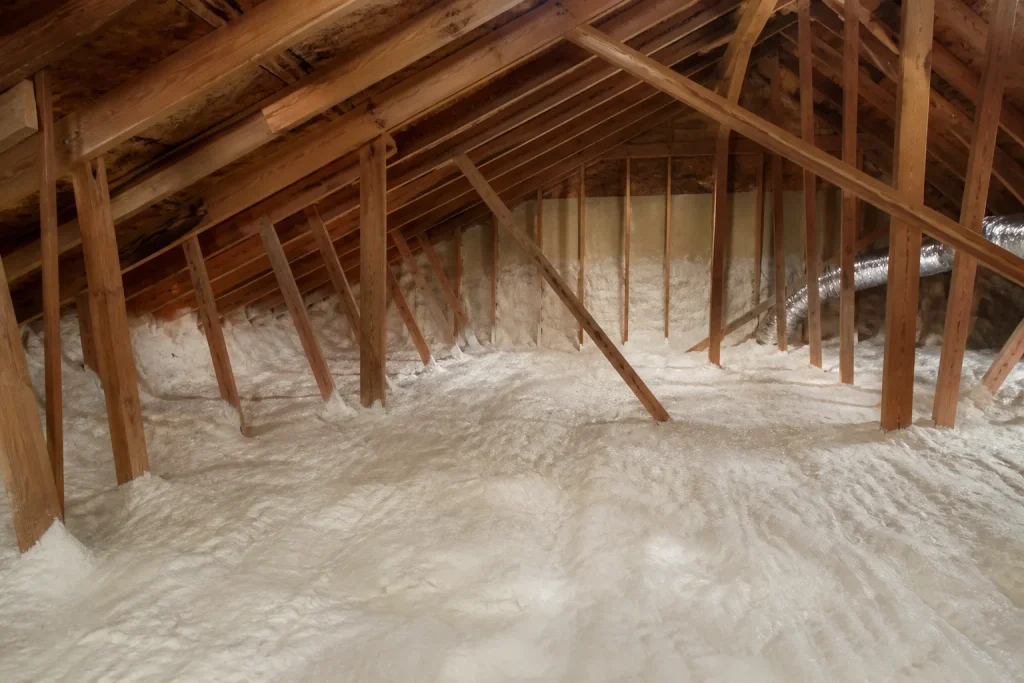
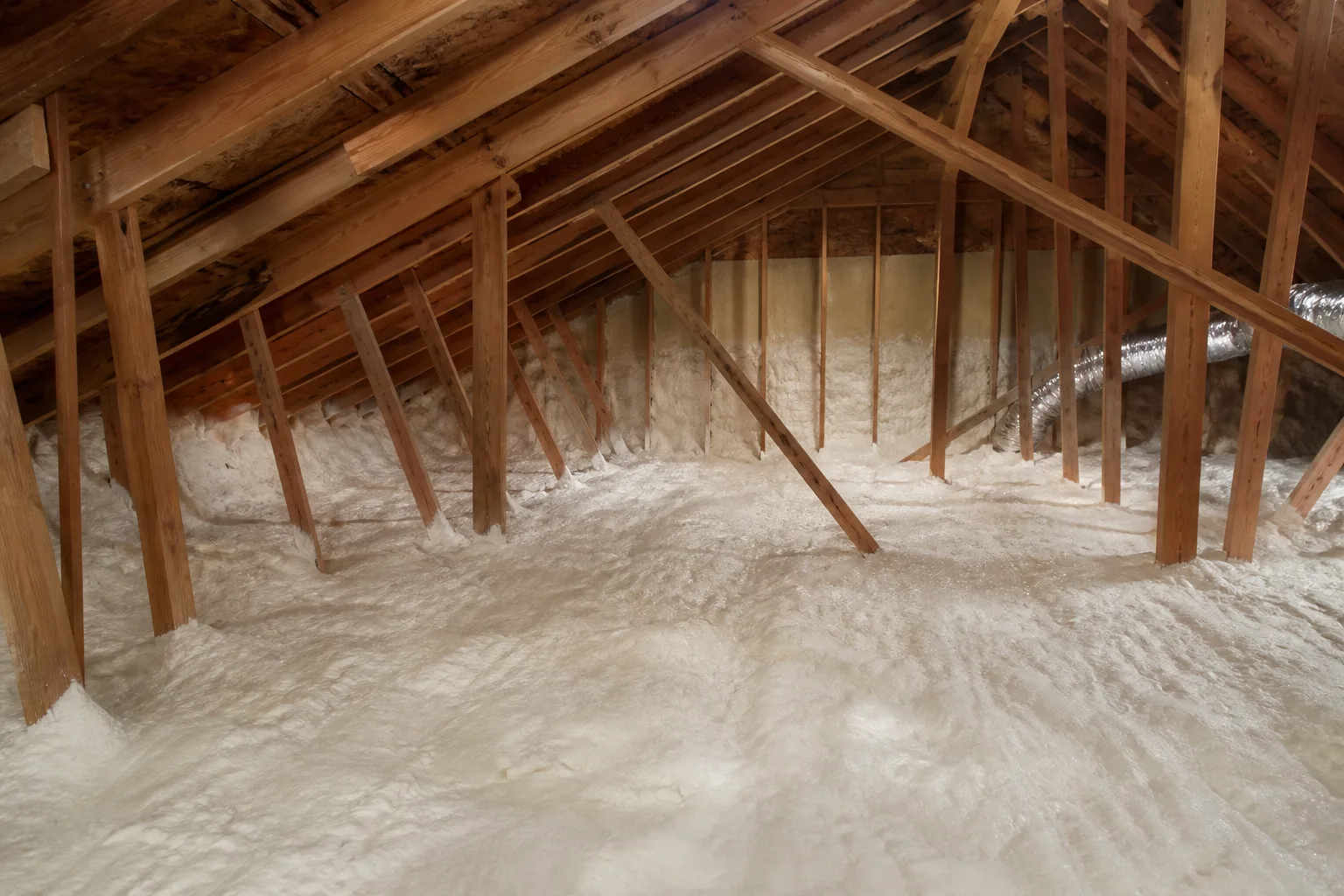
Open-cell Icynene earns its premium price in one specific Hesperia condition: an unvented conditioned attic, which is a technical way of saying the attic has no ridge vents, no gable vents, no soffit ventilation, and the thermal boundary of the home has been moved from the attic floor to the roofline. In a configuration like that, the attic becomes part of the conditioned envelope of the house. The temperature up there stays closer to the living space temperature, and the ductwork, which in most Hesperia homes runs through the attic, stops losing conditioned air into a 140-degree oven.
Air sealing is the real payoff. Fiberglass batts and blow-in products like GreenFiber cellulose slow conductive heat transfer, but they do not stop air movement. Air leaks through recessed light fixtures, top plates, electrical penetrations, plumbing vents, and the gap where the drywall meets the framing. In a typical Hesperia home built in a 1990s tract over in the Mesa or in newer subdivisions off Ranchero Road, those small gaps add up to the equivalent of leaving a window open year-round. Icynene open-cell foam, sprayed across the attic floor or up the roofline, seals those leaks permanently. The R-value is almost secondary. The energy savings on a home where ducts run through the attic, especially older duct systems with leaky seams, can be substantial precisely because you stop preconditioned air from escaping before it ever reaches the rooms.
We’ve pulled fiberglass batts out of attics in Hesperia where the underside was black with filtered dust, a sure sign that air had been moving through the insulation for years. Batts filter air. They don’t stop it. Icynene stops it. That’s the argument for spray foam in a sentence.
When Icynene Is the Wrong Move in Hesperia
If your Hesperia attic is a standard vented attic, meaning it has soffit vents, gable vents, or a ridge vent, open-cell Icynene on the attic floor is usually not the best value. Vented attics are designed to breathe. The outside air flows in through the soffits and out through the ridge, carrying heat and moisture away. In that assembly, the thermal boundary stays at the attic floor. You need maximum R-value per dollar, not air sealing, because the attic is already supposed to exchange air with the outside. Blown-in cellulose from GreenFiber or blown fiberglass from Owens Corning, Johns Manville, or Knauf gets you R-38 to R-60 for a fraction of the cost of spraying foam.
The second situation where open-cell Icynene fights you is humidity. Open-cell foam will allow water vapor to pass. During Hesperia’s monsoon weeks, outdoor dew points can climb into the 60s, and that moisture moves into the attic. In a vented attic, ventilation carries it away. In an unvented attic insulated with open-cell foam on the roofline, that vapor can condense against the underside of cold roof sheathing during winter nights when the roof surface drops below the dew point. Closed-cell foam, or an open-cell assembly with a vapor retarder painted over the foam, addresses that risk. We specify this carefully on every attic we quote in Hesperia, because the wrong vapor profile turns a good insulation project into a roofing failure nobody sees until the shingles come off.
A third scenario: if you’re insulating a detached garage, a workshop, or a storage building on a bare budget, spray foam is overkill. A simple blown-in attic insulation job handles that space for far less money, and the energy payoff on an unconditioned outbuilding doesn’t justify a premium foam system.
Cost Per R-Value: Icynene vs. Blown-In vs. Closed-Cell in a Hesperia Attic
Here’s the honest math for a typical 1,800-square-foot Hesperia attic, based on what we see across the high desert market:
- Icynene open-cell spray foam (attic floor or roofline): $1.10 to $1.80 per board foot, installed. For a 1,800-square-foot attic at R-30, expect $4,200 to $7,600, depending on depth, access, and prep work.
- Closed-cell spray foam (Icynene ProSeal or Demilec): $2.20 to $3.50 per board foot, installed. For the same 1,800-square-foot attic at R-30, $7,900 to $12,600. Vapor-resistant and structural, but a much larger check.
- GreenFiber blown-in cellulose: $1,200 to $2,400 for the same attic at R-38, including air sealing work around top plates and penetrations. The lowest cost per R-value in the high desert.
- Owens Corning or Johns Manville blown fiberglass: $1,400 to $2,800 at R-38, similar performance to cellulose with different moisture and settling behavior.
Breakeven math matters more than sticker price. If Icynene open-cell on a roofline cuts a Hesperia cooling bill by 22% to 28% on a home with attic ducts, and your summer electric bill is $340, you’re saving $75 to $95 a month during the four hottest months. That’s $300 to $380 a year. On a $6,000 retrofit, the simple payback runs 16 to 20 years, not counting rising utility rates or the added comfort of rooms that actually hold temperature. If the same upgrade stops a $12,000 duct replacement or makes a previously unusable bonus room comfortable, the payback looks very different. We walk through this math with every homeowner before quoting, because the right answer depends on your duct layout, your attic configuration, and your long-term plans for the house.
Get a sense of the full Attic Insulation in Hesperia options before settling on any one material.
The Installation Reality Most Homeowners Don’t Hear About
Spray foam installation is not like blowing in cellulose. The process is more involved, and you should know exactly what to expect before you sign a contract. First, the installers prep the attic: they cover exposed framing that shouldn’t get foam, mask off the access hatch, and run a ventilation plan for the work area. Then they run a proportioner and spray the liquid through a heated hose. The two chemical components mix at the gun tip and react within seconds, expanding into the foam you see on the finished product.
Open-cell Icynene cures quickly, usually within a few minutes to a few hours depending on heat and humidity. Hesperia’s dry heat actually helps cure time in summer. But the off-gassing window is the part homeowners get blindsided by. During and immediately after application, the foam releases volatile compounds as it reacts. Industry guidance says occupants should stay out of the home for a period after application, and the window varies by product and ventilation. With open-cell Icynene, the foam is typically odor-free within 24 hours, but we tell homeowners to plan for a full day away for the house to clear, and longer for sensitive individuals, pregnant women, or people with respiratory conditions. Do not let a contractor tell you it’s harmless and you can sleep there that night. Follow the manufacturer’s re-entry window to the letter, and ask for it in writing before work starts.
The other reality is access. If your Hesperia attic has a tight scuttle hole, a low-pitched roof, or existing insulation that needs to be pulled before spraying, the labor cost climbs. Spray foam is also not a DIY project, period. The equipment is specialized, the chemical reaction generates heat, and an improper mix produces foam that never cures or, worse, degrades and off-gasses indefinitely. This is one insulation category where professional installation is not optional.
For a deeper look at the method itself, see our Spray Foam Insulation in Hesperia page.
Which Icynene Line Riverstone Specifies for High Desert Attics
When the attic assembly calls for spray foam, we usually specify open-cell Icynene Classic for unvented attic floors and for roofline applications where the homeowner wants the air-sealing benefit without the premium price of closed-cell. The exception is when the roofline will be exposed to interior humidity from a shower, a pool, or a swamp cooler, because Hesperia homes still use evaporative coolers in older sections of town, and those add indoor moisture that open-cell foam lets through. In those cases we move to closed-cell Icynene ProSeal or a Demilec closed-cell equivalent, or we pair open-cell with a vapor retarder coating.
The product line decision matters less than the assembly design. A poorly designed attic with the finest foam on the market will underperform. Vapor profile, ventilation strategy, and duct location all matter more than brand name. That’s why we carry Icynene and Demilec plus six other product lines across every major insulation category. When someone asks us to compare Icynene to Demilec, the honest answer is that both are performance-validated closed- and open-cell systems, and the difference usually comes down to project specifications, availability, and cost. The material selection follows the attic diagnosis, not the other way around.
If you’re weighing spray foam against a simpler Blown In Insulation in Hesperia retrofit, the conversation should start with your attic’s design, not a brand name.
The Bottom Line
Icynene open-cell spray foam has a specific, defensible role in Hesperia attics: unvented conditioned attic assemblies with ductwork in the attic, where air sealing delivers more benefit than additional R-value, and where the moisture profile of open-cell foam is accounted for. Outside that use case, a vented Hesperia attic usually gets better insulation-per-dollar from blown-in cellulose or fiberglass. The brand is not the point. The assembly is the point. If you’re in Hesperia and trying to sort out whether Icynene, Demilec, GreenFiber, Owens Corning, Johns Manville, or Knauf is the right material for your attic, call us at (866) 950-6425. Riverstone Insulation offers free estimates, and we’ll give you a material-matched recommendation without pushing a product line that doesn’t fit your structure.
Frequently Asked Questions
Only if your attic is unvented, your ductwork runs through the attic, and air sealing is a priority. In a standard vented Hesperia attic, blown-in insulation delivers more R-value per dollar. Call (866) 950-6425 to have us assess your specific attic before you spend on foam.
Open-cell Icynene is vapor-permeable, meaning water vapor moves through it. During Hesperia’s monsoon humidity spikes, a poorly designed open-cell roof assembly can trap moisture against cold sheathing. Closed-cell foam or a vapor retarder solves that. We specify the correct vapor profile for every attic we quote.
Re-entry windows vary by product line, but plan on staying out for at least 24 hours, and longer for sensitive individuals. Get the manufacturer’s re-entry window in writing before work starts, and make sure your installer follows it.
Generally no. Existing insulation must be removed first so the foam can adhere properly to the attic floor or roofline. We factor removal and disposal into every Hesperia spray foam quote so there are no surprises on installation day.
Written by the team at Riverstone Insulation, serving Hesperia since 2013.
Need Insulation Help?
Call Riverstone Insulation — licensed & insured, here with fast after-hours help in Hesperia.
(866) 950-6425